Saturday, 3 February 2018

Truss

A truss from Colville. Name just about visible top if you click to enlarge.

Group search key: smc.

Girder

A girder from Lanarkshire, somewhere in the turbine hall, with embossed name clearly visible if you click to enlarge.

Group search key: smc.

The adverts are coming!

Regular readers will recall that I bought some new shoes from Cotswolds recently.

The new shoes have been fine, but I am now finding advertisements from Cotswolds popping up in all sorts of unlikely places. So I go to the website of some quite unrelated company for some reason or other. It has allocated a chunk of its opening screen to dynamic advertising. It goes to google and matches my profile with google with its portfolio of advertisers. No doubt the date, the time of day and my present location get added in to. And out of the mix pops Cotswolds.

Don't much like it, but there is not much to be done about it, as it would take mass political action of a sort unlikely to happen any time soon. We all have more important things to worry about. But maybe I could get Corbyn to take an interest, in the margins of his upcoming visit to a shelter near here for fallen women?

Furthermore, it occurs to me that the Cotswolds people maybe need to tune their algorithm a bit. What is the point of serving me up with advertisements when I have just bought a pair of shoes, from them as it happens? Surely what they need is a bring-forward marker for six months times when the new ones have worn out? Unless, of course, what I am getting is the tail end of such a marker. But I don't think so; the timing does not seem right for that. All too complicated for this time on a cold winter's morning.

Reference 1: http://psmv3.blogspot.co.uk/2018/01/kingston-upon-thames.html.

Steel day

A week or so ago I felt the need to check out the steel memories evoked by the visit to the Adelpi area to the east of Charing Cross railway station and noticed at reference 1. So off to London Town.

On the train entertained by a waking, visual hallucination, perhaps the third time such a thing had happened in as many days. Neither black and white nor gray scale, but in rather muted colours. Stationary images rather than images involving movement. One, for example, of a mathematically flavoured text from a book, complete with interesting mathematical symbols like '∑'. Another was the interior of a railway carriage, loosely based on those offered by Southwestern Trains.

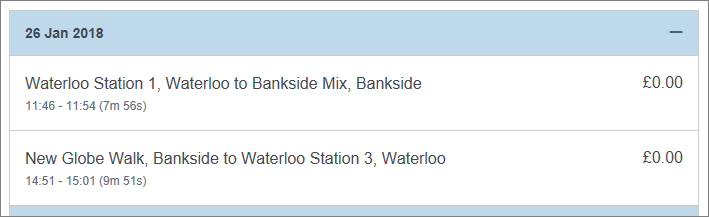
Just under 8 minutes from Waterloo to what TFL calls Bankside Mix but which I call the Blue Fin building. First stop the Kirkaldy Testing Museum across the road to check its opening times.

Next, called in one of those Italian restaurants in and around Blue Fin which double as delicatessens to ask about 'Greco di Tufo', to find a very tall and very civil Italian chap who explained that it was made from one of the many grapes used in Italy, probably more popular outside Italy than in. Also a speciality of Campania/Naples, so maybe I would do better in a shop which specialised in that area. Which explains why we first came across the stuff in the Neapolitan Kitchen in Ewell. See, for example, reference 2. All that said, he usually had some in, but not on this day.

On into the turbine hall at Tate Modern to search out the girders made by the Kirkcaldy Steel Company, to find a carpet down the ramp, intended for children to roll down, and the floor filled up with not very big swings, mostly three seaters. Quite a lot of young people - say 15-20 rather than 0-5 - swinging on them. I decided against taking a roll myself. Perhaps if BH had been there to cheer me on? All good fun, but it also struck me as rather silly. Is that the best that the biggest and most important modern art gallery in the UK can offer?

The search failed. Most of the vertical girders appeared to have been made by the Lanarkshire Steel Company, with these words being embossed in very low relief (presumably during the last pass of the girder through the rollers), not the high relief that I remembered at all. While up in the roof, visible from the new bridge, there were some much lighter roof trusses made by the Colville Steel Company. With the name in this case being even fainter than those of the people from Lanarkshire, perhaps stamped in the steel after the event, rather than rolled in the steel in low relief. Which all goes to show how dodgy memories can be, with these very distinct memories of the Kirkcaldy Steel Company being embossed in high relief being completely wrong, albeit a patchwork of things that were completely right.

And so into a quick tour down the new extension, known to some as the Blatnavik Building. A lot of plain oak to be seen on the floors, some of it already stained by water ingress from somewhere or other. I wondered how well it was going to wear. Handsome galleries, but full of what for me was mostly rubbish. So a bit like the big art museum in Ottawa: fine art gallery, pity about the art. One piece, three identical sheets of lovingly mounted plain white cardboard, might have been a generous gift from the gallery in Albemarle Street, noticed at reference 7.

Among the rubbish though there was one bit of clever fun. A sort of shiny metallic cube with portholes. You peered through the portholes to see your image reflected all over the place. I managed to get ticked off for standing too close.

I had assumed that Mr. Blatnavik was a very rich man of Russian extraction, with his money coming from the carving up which took place after the collapse of the Soviet Union. One of the oligarchs, more or less mixed up with various kinds of criminality. But a glance at reference 5 suggests that this is not altogether fair. He might have started out in the carving up, but rapidly diversified into the US and into all kinds of other assets. A common or garden tycoon of the ordinary sort. See reference 6. A big donor in this country, and I dare say others, to the extent of being made a knight. See reference 4 for one of his other efforts.

Out to lunch in what turned out to be a Turkish restaurant in New Globe Walk opposite the Globe Theatre.

Mixed starters, including humus, a parsley dominated dab of salad and some kind of sausage. Bread good. Main course a sort of vegetarian pizza, rather good. A speciality of the house (which sported a full on, brick built pizza oven, with wooden shovels) called a pide. A truly splendid dessert made of semi-dry apricots stuffed with an almond and some kind of white cream, chopped green stuff on top, probably pistachios. A glass of decent white wine and some Turkish coffee. Good ambience, not busy, which was just as well as I could see service being slow if it were. All in all, an excellent lunch, clearly a place to be visited again. To think how many times we must have passed the place by, without taking a proper look, around visits to the Globe. A small chain, see reference 8.

On the way back to Waterloo, spotted a big crane in the big building site at the Blackfriars end of Stamford Street. A yellow crane from Ainscough, one of those lorry mounted telescopics, with a stayed jib on the end of the telescopic portion. The sort of thing noticed by a correspondent at reference 9.

PS: later: it now occurs to me that 'pide' is probably the same word as our 'pizza'. So did the Italians give pizza to the Turks or did the Turks give pide to the Italians? They were certainly up close and personal for a good part of the 15th and 16th centuries.

Reference 1: http://psmv3.blogspot.co.uk/2018/01/fake-23.html.

Reference 2: http://psmv3.blogspot.co.uk/2017/09/dinner.html.

Reference 3: http://testingmuseum.org.uk/.

Reference 4: https://www.bsg.ox.ac.uk/.

Reference 5: https://en.wikipedia.org/wiki/Leonard_Blavatnik.

Reference 6: https://www.accessindustries.com/.

Reference 7: http://psmv3.blogspot.co.uk/2016/03/albemarle-1.html.

Reference 8: https://www.tasrestaurants.co.uk/.

Reference 9: http://psmv3.blogspot.co.uk/2017/04/up-north-1_4.html.

Group search key: smc.

Friday, 2 February 2018

Haig two

I have now finished the second volume of Duff Cooper's biography of Haig, first noticed at reference 1.

Having complained about the maps in Volume 1, I was pleased to find a much more helpful map, well into Volume 2, illustrated left. Which brought home to me how vulnerable the British position, occupying the northern portion of the line, was. With our backs to the channel ports which Admiral Bacon was hard put to keep open for business - but without which we would probably have been finished. See references 2 and 3.

Furthermore, the Germans were massed against us and against the northern part of the line held by the French. Clearly visible in the density of the little black blocks in the illustration. Both they and Haig thought that they would have won the war had they been able to drive a wedge between the British and the French armies, something they came close to doing at the beginning of 1918. There was also the consideration of munition factory feeding coal mines just behind the British lines.

Otherwise the maps were as bad as those in Volume 1, although rather late in the day I found that I had Michelin maps for most of the area in question in their 1/200,000 series. With the key area being the top right hand portion of sheet 52, north and east of Amiens. The Somme. See reference 4.

1917 saw the wearing down work of the Somme carrying on. Also the swift rise and fall of Nivelle on the French side, a general who had had the backing of Lloyd George, our new Prime Minister. Also something of a panic on the naval front, partly as a result of the damage done by German submarines, before our navy got their measure. But the submarines also brought the US into the war, with their large and largely untapped supplies of men, munitions and food.

Haig, unlike most of the politicians at home, thought that 1918 would see the end of the war. Starting with what he thought would be the last ditch offensive of the Germans, followed by the winning offensive of the allies. And so it turned out. Something of a gamble, because if he had been wrong, we would have been in a bad position to have carried on into 1919 and beyond. And  as it was there were some anxious moments while the German offensive ground to a halt in May.

The allies went over to the attack in August, an attack which ended by breaching the formidable Hindenburg line - still well inside France but a decisive victory. At which point the Germans ask for an armistice and the allies start to argue amongst themselves about the terms to be offered.

On page 396 we have Haig's summary of the position. Germans beat, but would continue to fight well if it came to defending their homeland. French, worn out by four years of war. Americans, keen and coming on well, but not yet a serious force. British, in fairly good shape but stretched very thin. Not in a good state to carry on into 1919. Time to come to terms. And so it turned out, even if the eventual peace terms, agreed six months later in Versailles, were overly and unrealistically harsh.

On a lighter note, there is much talk of lunch boxes, with occasional fine dining. Which Haig did not care for at lunch time, not caring for the loss of efficiency in the afternoon. A fine present of chocolate from (I think) Foch at a time when chocolate was getting scarce. Some talk of church services, some according to the Scottish rite, and some in the church at Pont Street in London, a handsome church which we have visited ourselves (noticed at reference 5).

The biography has been blamed for being too soft on Haig. But I am left, as I was at the end of Volume 1, thinking that he had done pretty well, all things considered. He was a fine soldier, but one whose lack of a ready tongue told against him in his dealings with politicians and journalists. Plus, he was obliged to work with a Prime Minister, Lloyd George, who neither liked nor trusted him - without feeling able to get rid of him. While Haig took the view that it was his duty to serve until sacked - which, in the event, he was not. He was also, we are told, rather shy.

Whereas I was left thinking the less of Lloyd George. He might have held the Home Front together at a difficult time, but he was far too keen on wheezes which might win the war without pain. Far too keen as far as Haig was concerned on adventures away from the Western Front. Far too given to interference in operational matters which he did not (according to the soldiers) understand. A fault which he shared with Churchill.

There was also the problem with General Wilson. Despite an indifferent record as a corps commander, he spent much of the war in senior advisory positions, ending up as Chief of the Imperial General Staff. Something of a thorn in Haig's side, although relations remained civilised. According to Duff Cooper, rather too fond of intrigue. Wilson was also an Irish protestant from the middle of that island, a good talker and somewhat mixed up with Unionist politics. High Tory. He ended up by being assassinated by the IRA, on his front door step in Belgravia in 1922.

In defence of both Haig and Wilson, I was left very impressed by the problems involved in getting the field commanders of the three armies - the British, the French and the American, their nominal military superiors back home and the politicians back home to agree on what was to be done and to work together. Complicated by the fact that the French were fighting at home with the front only a drive away from Paris - so it had to be their show - even when others thought that they were wrong about something. By the fact that it was the politicians who had to deliver the Home Front - and to deliver all the men and munitions that the soldiers wanted. All things considered, all those involved did not do so badly. By the facts that there was a Belgium army and a king who wanted to command it and a Portuguese contingent. A not insignificant contingent with losses of  8,000 dead, 14,000 wounded and 12,000 prisoners or missing.

Reference 1: http://psmv3.blogspot.co.uk/2018/01/haig-one.html.

Reference 2: http://psmv2.blogspot.co.uk/2014/05/bacon-and-out.html.

Reference 3: http://psmv2.blogspot.co.uk/2014/04/the-dover-patrol.html.

Reference 4: https://www.viamichelin.com/. A serious challenge to gmaps, certainly in France. Proper maps, a sort of cut price version of our Ordnance Survey maps, a lot better than the one size fits all maps from Google.

Reference 5: http://pumpkinstrokemarrow.blogspot.co.uk/search?q=Presbyterian+Church+of+Scotland. We were on one visit, quite possibly this one, pleased to find someone in the church who remembered a lady we once knew quite well, who had been one of the elders there. Presumably their regular congregation is now rather small for a rather large church.

Complaint

Prompted by the news in yesterday's Guardian that some busy person in the municipal art gallery at Manchester has seen fit to take down the well known picture illustrated on the grounds that it objectifies women, I want to complain about the unsightly advertisements placed by First Utility which objectify men.

Not only do they objectify men, but we have to put up with a loud, vulgar, strip-cartoon picture occupying whole pages of our daily newspapers. At least, now that we have been warned that the Manchester City Art Gallery has porn in its walls, we can choose not to go there. Not such an easy choice in the case of out daily newspaper.

Oddly, neither Google nor Bing seem to know anything about the picture in question, so I am unable to include it here. The best I can do is suggest that it is something to do with 'Masters of the Universe' from Mattel. Something which both Google and Bing do know about.

PS: there was the further thought that if the chattering classes, the great and the good spent as much time worrying about the housing crisis or the distribution of wealth in this country as they do about stuff like this, the country might be a better place.

Reference 1: Hylas and the Nymphs - John William Waterhouse - 1896.

Reference 2: https://www.first-utility.com/.

Reference 3: http://corporate.mattel.com/#&panel1-1.

Thursday, 1 February 2018

A new practise

I had heard of the practise of employing eunuchs about one’s palace, in part because they could be employed in one’s harem without fear of them doing anything improper, at least on their own account, in part because their lack of children made them less likely to indulge in family intrigues, with intrigues of one sort or another being something of a problem in palaces.

I had also heard of monarchs who did not allow many of their subjects the privilege of looking at them. Where the form was for subjects to prostrate themselves on the ground at the approach of the monarch. I think the Aztec emperor may have been one such. While a concubine of the Chinese emperor was only allowed to consult her doctor by poking her left hand through the curtains of her litter. Doctors who, in consequence, became very good at reading palms.

But today I read of a new practise. It seems that the Ottoman Sultan, in his glory days, a long time ago now, could not bear that there should be idle chatter in his presence, or, indeed, any sort of chatter at all, and to this end hired a squad of deaf, and presumably dumb, retainers to look after him, retainers who managed their work by means of a sign language. With the additional advantage that they would be unable to sneak on any of the idle conversations that he might have with his intimates. Perhaps his concubines, generals or chiefs of police.

Unfortunately, knowledge of this sign language eventually leaked out to the court at large, with many of the courtiers learning this new language. And maybe some of the retainers learned to lip read. All of which meant in time that a lot of the substance of the aforementioned idle conversations did leak out. All privacy was lost.

And we all know what happened to the Ottoman empire in the end.

And should you read and wonder about the gentleman of the stool at reference 1, the stool in question is not the chaise percĂ©e of the English monarchy, where the gentleman of the stool was another important and honourable office, rather a stool to be used for mounting the imperial mule.

I learned about this from the report at reference 1 about the paper at reference 2 from the august journal at reference 3. Unusually for these days, this paper has not leaked out into the internet at large and so I am not able to add much to the little that I learned about all this from reference 1.

And lastly, given that the JSTOR mission is to 'contextualise current events with scholarship', I wonder why this paper, from the fifteen year old depths of Islamic deaf scholarship should surface now? Is is just like any old newspaper of the ordinary sort, which keeps a pile of trivia to hand against a rainy day, a day when news is slow?

PS: I last noticed JSTOR nearly two years ago at reference 4. Perhaps I ought to have another go at their library. Plus, DPLA no help today with the furniture tax of reference 4, only offering a couple of bits of unrelated oral history from the Mid West, so perhaps JSTOR can do better?

Reference 1: https://daily.jstor.org/the-secret-sign-language-of-the-ottoman-court/.

Reference 2: the Deaf in Ottoman Syria, 16th - 18th Centuries - Sara Scalenghe – 2005.

Reference 3: http://www.arabstudiesjournal.org/.

Reference 4: http://psmv2.blogspot.co.uk/2016/01/perplexed.html.