Showing posts sorted by relevance for query westminster abbey. Sort by date Show all posts

Wednesday, 8 August 2018

Better late than never

Yesterday evening I was reading about Westminster Abbey in the book noticed at reference 1, detailed at reference 2 and fully illustrated at reference 3. You can also buy a modern, paperback version from Amazon.

Not for the first time, I came across the word 'ashlar', which I think I have taken to be a sort of fine grained stone, probably some sort of limestone, good for the fancy stone work of large churches. For some reason yesterday evening I got around to looking the word up, to find that it is not a sort of stone at all, rather a particular way of working with stone, in which each block is carefully cut to fit in with its neighbours, to the point where the use of mortar is almost superfluous.

While the faces of ashlar blocks are often square, they may be some other kind of rectangle, in the way of bricks, and need not be rectangular at all. Their cutting to fit with each other is the defining feature.

Often used to face up walls and pillars, the interior of which might be mortar bound stone rubble.

The same sort of thing sometimes happens when reading Maigret. You come across a word that you don't know but guess the meaning, which seems to work OK for a bit. Then you get around to looking it up to find that you were quite wrong.

Reference 1: http://psmv3.blogspot.com/2017/03/a-bit-of-heritage.html.

Reference 2: Westminster Abbey, historically described - Feasey, Micklethwaite and Bell - 1899.

Reference 3: https://www.anglotopia.net/british-history/archives-westminster-abbey-1899/. With thanks for the use of one of their pictures, taken from reference 2. Better than I could manage with my telephone.

Friday, 10 August 2018

Abbey

Probably prompted by reading about Eric Gill, I decided to pay a visit to Westminster Abbey last week, the first time for some years.

Visitors
So off to their website, very much the sort of thing one would expect for a major attraction, doing according to the snip above, between one and two million visitors a year, maybe 5,000 an average day. Bearing in mind that I have no idea whether these statista people (reference 1) are reliable. Slightly puzzled by the huge queues, given that this is only four or five times as many people as they get at Polesden Lacey, and one rarely sees queues - or indeed crowds - there. Maybe they all get lost in the bigger space. Maybe queue theory says there is some tipping point at which queues build up fast.

With the result of all this being that I get a semi-timed ticket, that is to say for the 1130-1330 slot, rather than the more specific time you might get at, for example, the Tate Modern. I take with me our Jarrold's Guide to the Abbey, purchased in 2002 when admission to the Abbey was a paltry £6, compared with the online price of £20 now.

On the train, two middle aged ladies get on at Wimbledon, sit down opposite me and start nattering away in some unknown language. Pale skins, western dress, fairly smart. Eyebrows shaved off and replaced by black paint. Eventually curiosity gets the better of me and I find out that they are talking Arabic, variety Iraq. They tell me that the comprehensibility of other peoples' Arabic decreases with distance, so that from Morocco is getting a bit difficult for them. Not least because of all the French that has sneaked in.

The missing Bullingdon
Pulled a Bullingdon at Vauxhall and pedalled off to Smith Square, just behind the Abbey. Oddly TFL seem to have lost their record of this journey, the first time they have done such a thing. Let's hope this does not result in any unexpected charges. My record included above, including the irritating yellow cycles. To my mind, it would be a lot more sensible if these competitors to TFL were banned. TFL have a much better system, a system which is in place and working well. Why clutter the place up with other systems which are going to suck money away from TFL? A nice comfortable public sector monopoly should rule in this matter.

Carex pendula
Came across an usual use of what looked like carex pendula as a bedding plant in Tufton Street, recently mowed. Looked like it was doing alright.

Into the Abbey via Dean's Yard where I was surprised to find a taxi drivers' hut, still green but rather derelict looking. What was it doing there? Had it been removed from the outside on the grounds that it was a security risk there?

The queues were very big and it was very hot. However, the talk of fast track on the website kicked in once I had got through the security check and I could skip the second and larger queue, to find myself inside a very busy Abbey - but still pleasantly cool after the outside world. I was quite struck by the state of undress of many of the young ladies, and was reminded of the occasional trouble in the far east with young ladies from the west visiting temples in a state of undress. To someone of my age, despite being an atheist, it all seems a bit disrespectful, but thinking about it now I am not so sure: perhaps thoughtless would be a better word, there being no intention to show disrespect.

Intrigued by the variety of style and ornament of the large coffins arranged around the High Altar. Some of them included friezes of wooden human figures, maybe a foot or so high, all with their faces cut off, presumably at some time when Puritans were getting excited by images in churches. Just the sort of thing we have noticed in the past at Ely Cathedral. Also by the fact that a couple of earls seemed to have wangled pole positions right next to the High Altar, not kings at all. Perhaps they were top men at the time this part of the Abbey was built by Henry III in the middle of the thirteenth century. Henry V got a good spot too, right behind the shrine of the Confessor.

Otherwise, the memorials were, certainly to some extent, grouped by profession. So naval people here, politicians there and so on. But there were an awful lot of them, and what with the large stacks of chairs (presumably for occasional use in the nave), it was not always easy to see the church itself. One got a sense of the height of the place and the apse looked well, but that was about it. I can't imagine that St. Benedict - under whose rule the Abbey lived for the first few hundred years of its life - would have approved.

Very flashy Lady Chapel added at the east end for Henry VII and his lady, now used by the Order of Bath for their occasional meetings. On which I came across an informative and interesting trusty, whom I suspected of being ex-army, but I did not like to ask, not being an ex-military man myself. Amused by the high chairs originally being reserved for the knights proper, with the low chairs being for their squires (écuyers according to the tickets) and other hangers on.

Didn't think much of the stained glass. Rose windows disappointing.

Ceiling, from Pinterest
I had not noticed the ceiling decoration before, with geometric designs in paint, around the ribs and bosses.

A communion service going on in the nave, led by a priest from Scotland, quite well attended by properly behaved visitors - if a little casual in their dress, by the standards of divine service in Agatha Christie costume dramas.

A view from upstairs
Quite by chance came across the new gallery in the triforium, not long opened. Quiet and excellent value for a fiver, with the triforium being interesting in itself - plus one had the opportunity to be up close and personal with the stonework that one usually only sees from a distance. Or as BH put it later, stuff which had been intended for the private consumption of the deity himself. Consecrated to his greater glory, rather than to our entertainment. From where, I now associate to the mysteries of the Greeks, only available to adepts and initiates. All that stuff which is and which should be withheld from the hoi polloi. Winston Churchill would have understood - and would, once again, have been wrong.

Followed by interesting views of the Abbey below - including an excellent view down the length of the sanctuary, quire and nave, all the way to the west door - and a good selection of stuff moved up from the museum. Some of it rather strange. Handsome new spiral staircase tacked onto the side of the old building, maybe between the Lady Chapel and one of the smaller chapels adjacent.

To the chapter house to see the three inch heating pipe running around, underneath the remnants of ancient wall paintings. A place which must have been very cold in the winter at the time of its construction back at the end of the middle ages. To the much smaller pyx chamber next door to see its heavy duty double door, a reminder of its one-time function as a treasure chamber.

Second Bullingdon of the day from Storey's Gate, Westminster to Stamford Street, South Bank in 11 minutes and 16 seconds. Very few pedal rickshaws parked up in the cycle lane on this occasion. Down to Konditur & Cook to see what they could do in the way of hot weather cakes and eventually settled for a summer fruits frangipane tart, after a scare about cranberries. On the second time of asking, it turned out that there was only a trace rather than an ingredient, along the way being amused by the shop girl saying that she would ask her decorator about it.

Much waffle from the guard in my delayed train about red lights and passenger safety, waffle which served to camouflage a straightforward signal failure.

Stopped at Raynes Park to collect a boxed set of books about Minecraft which might help me keep up with the grandchildren which do that, a game which might be displacing Lego among the amusements of older boys. (I don't suppose many girls do it despite the best efforts of all concerned). Plus a conveniently small copy of Büchner's Woyseck in the original German, all 29 pages of it. Made up with 'Leonce und Lena'. 2 euros from Philipp Reclam jun. Stuttgart. See references 3 and 4. Sadly, more or less useless, as I don't do German and I can't see these fragments of a play ever being put on here in anything close to the original.

Home to a modest celebration involving baked cod loins from Waitrose (what used to be less grandly called cod fillet when I was small and cod was cheap), the cake from Konditur & Cook and some of Waitrose's finest white, that is to say Chassagne-Montrachet Morgeot, 2015, out of Louis Jadot.

Cake
Wine
All very good, and the cake had indeed survived the heat on the way home. We passed on the Calvados, bought against the occasion, but having done enough for one day.
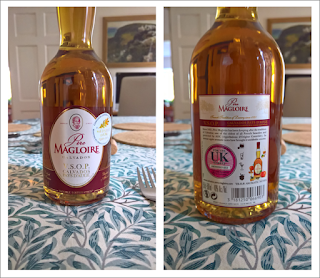
Spirit
Note the Holman Hunt sheep in the background. It seems that he was much admired by French painters of his day for his skill in painting the thin part of a sheep's ear with the sun behind it.

In the evening, I turned out the old picture book about the abbey, noticed at reference 5 and where I was pleased to find handsome photographs of most of the things that had struck me during the day. And to read, once again, a little of the history of the place.

Reference 1: https://www.statista.com/. 'Within just a few years, Statista managed to establish itself as a leading provider of market and consumer data. Over 500 visionaries, experts and doers continuously reinvent Statista, thereby constantly developing successful new products and business models'.

Reference 2: https://minecraft.net/en-us/.

Reference 3: https://psmv3.blogspot.com/2017/06/woyzeck-two.html.

Reference 4: https://www.reclam.shop/service/impressum.

Reference 5: https://psmv3.blogspot.com/2018/08/better-late-than-never.html.

Wednesday, 8 August 2018

Footnote

The Digital Public Library of America (DPLA or DP.LA) does not know about Mr. Feasey (of the last post) but it does know about Mr. Micklethwaite, turning up 6 items; 4 versions of reference 3 and two others. But not the Westminster Abbey book, so one of the 360 or so copies printed has yet to find its way into the digital maw of DPLA.

'The ornaments of the rubric' was originally priced at 5 shillings, that is to say 25 pence in current coin, and went through several editions. With DPLA offering at least one, good quality copy online.

I have yet to work out what the theme of the work is. Maybe after breakfast.

PS: some time later: the work turns out to be an earnest and learned tract about the ornaments and furnishings which are permitted in churches of the Anglican Community. With the general idea being to restore the status quo of the second year of the reign of King Edward VI, as per the introduction to the Book of Common Prayer. A sort of catalogue raisonné of the ornaments and furnishings which should be found in our parish churches. With my only quibble being that the relevant (penultimate) paragraph of the Act of Uniformity enacted by Elizabeth I to be found in my copy of the book in question reproduces the sense but not the exact words quoted by Micklethwaite and I can't find the corresponding bit of the new Act of Uniformity enacted by Charles II which follows immediately after. So a relic of theological disputes a century dead. Or maybe not? Maybe this sort of stuff is still meat and drink to all those ladies and second career types (like the present incumbent at Canterbury) flooding into the Anglican priesthood.

Reference 1: https://dp.la/.

Reference 2: Westminster Abbey, historically described - Feasey, Micklethwaite and Bell - 1899.

Reference 3: The ornaments of the rubric - Micklethwaite, J. T. - 1898.

Friday, 31 March 2017

A bit of heritage

A couple of engravings which fell out of our copy of a 100 year old book about Westminster Abbey, in which the abbey is historically described by one Henry John Feasey, a book which is illustrated with 75 rather handsome black and white photographs. Binding rotted, so we have a loose leaf book, albeit still in the original stout green boards. Said to be one of just 360 printed, but not numbered. So who knows where all this leaves it from a collectibles point of view.

The engravings turn out to come from Harrison's edition of Rapin's ten volume Histoire d'Angleterre, published around 1725. With Rapin being an expatriate Frenchman and with Harrison's English edition coming out around 1786, some sixty years later. At least 1786 is the date on the bottom of one of the engravings, so maybe these two engravings, cut out of some copy of said book, are over 200 years old.

Google suggests copperplate engravings and I presume that it is plate marks which are just about visible on both right hand margins. Drawn by Gravelot (of reference 1) and engraved by Goldar (of reference 2). To my mind of antiquarian, rather than artistic interest. But I also wondered at the amount of time which would be needed to produce work of this sort: perhaps the two artists earned a good deal less than the rich dilletantes who would have bought it. Or perhaps rich libertines who needed some etchings with which to entice the ladies in. Chaps who would probably not know the difference between an engraving and an etching. And with this last being left as an exercise for the reader.

PS: efforts to rotate and trim the original (Lumia) photograph to something neat defeated by scroll arrows.

Reference 1: https://en.wikipedia.org/wiki/Hubert-Fran%C3%A7ois_Gravelot.

Reference 2: https://en.wikipedia.org/wiki/John_Goldar.

Sunday, 12 August 2018

Abbey two

I followed up the visit to the Abbey noticed at reference 1 with a second visit last week, in the rain. Enough rain to use the folding umbrella that I took along with me.

First point of interest was the large fig tree across the tracks from platform 4 at Epsom Station, on which I was not even sure that I could make out any green fruit. While our next door neighbour gave us half a dozen ripe figs from their much smaller tree only last week. What was the difference? The one at Epsom Station probably got a lot more sun than the one we had fruit from.

Then I had a pleasant mum on the train taking her young son to the Science Museum. We were able to agree that there were plenty of cake shops in the vicinity of the Museum with which to console the adults.

Pulled Bullingdon from Concert Hall Approach 1, South Bank to make Storey's Gate, Westminster in 7 minutes and 13 seconds. Still drizzling, but I had a raincoat and the journey was not long enough for the rain to be a pain.

Queues at the Abbey a lot longer than last time, despite the rain, so a wait of  maybe 10 to 15 minutes to get to the security check, after which I was fast tracked with my ticket from the Internet. Entertained while I was waiting by a family over from Connecticut for a week, with three not so young children, who had put in a lot of premier division sights in the course of their week here, often more than one a day and including the film studio at reference 3 at which the Potter films were made. Will we ever make it there? We have been in an audience for the making of a TV comedy, and we do get to see the odd bit of outdoor filming, but we have never been in a full-on film studio. Perhaps we ought to get ourselves to the film before seeing the set of the film. The family were due to fly back Saturday, back to work Monday. With work for one of them being starting college at somewhere involving Jesuits. Probably the place at reference 2. Only in the US of A - although with our flourishing faith schools who knows? Thank you, Mr. Blair. Also by a rather cross Japanese lady who was remonstrating with one of the trusties about how she had already been waiting an hour in the rain. The trusties seemed to have a certain amount of discretion in these matters, with the result she was led off somewhere or other, perhaps to some other queue.

Took some notice of the two fancy screens: one between the nave and the choir and one at the back of the High Altar, the one behind the ancient pavement. No idea how old they were.

Fair number of iron bars tying things together in the ambulatory round the Shrine - reminding me of the iron gothic of Victorian railway stations. Rather detracting from the intended effects, from the vistas of stone.

The tombs seemed terribly jumbled up, with it being very much a matter of pot-luck what spot you got. And you certainly could not rely on your spot remaining your spot, with all kinds of smaller memorials being pushed into the margins of larger memorials. With some memorials being cut about to make way for something or other.

Starting to get the hang of the crowds, which behaved rather like a river, with lots of odd places out of the current where one could sit back and take things in properly.

Puzzled by some of the memorials having what appeared to be headings in Hebrew. Was this a passing fashion at some point in the history of the place? There are certainly fads and fashions in other aspects of the memorial business, sometimes very visible in churchyards out in the country, where a particular wheeze by a particular mason is popular for a few decades, then replaced by a successor. Sic transit gloria mundi in every way.

Puzzled also by a lot of the Jacobean memorials, from which I found it hard to extract the name of the chief occupant, seemingly lost in a maze of Latin explaining all the titles, partners, children and other virtues of whoever it was.

The communion service was, on this occasion, led by a lady.

I found the Abbey servants corner in the floor of one of the arms of the cloisters, but no Micklethwaite, the one of reference 4. All kinds of other people, lay and ecclesiastical, but not him. The nearest I got was the abbey plumber, illustrated. We thought that maybe he was more to do with the lead on the roof upstairs, the waterworks lead downstairs not being strongly developed at that time.

Back to Central Hall for a spot of vegetable soup, to notice that they had not changed the rather flashy display of pink and red flowers on the stairs down to the café - which were then poked and found to be plastic. But a convenient spot for a spot of canteen lunch, neither empty nor crowded, and it did not really matter that I did not much care for the soup or that the bread rolls were a bit fresh out of the freezer.

Out to be entertained by an interesting silver and glass coach, a sort of pastiche of a royal coach, drawn by a couple of grays down Storey's Gate. Plus a couple of coachmen on the box. Seemingly, a Japanese couple on some sort of wedding bash, complete with morning suit, white wedding dress, the works.

Second Bullindon took me from Storey's Gate to the pole position at Waterloo Station 3 in 9 minutes 35 seconds. One day I may get around to checking all these times. Do I make a habit of taking longer on the way back?

Struggled with the self-service machine in Smiths, while he machine at the entrance to the platforms struggled with my ticket - as it had done on exit a few hours previously and it did no better when I arrived at Epsom. Southern Trains tickets again. While Southwestern Trains trains had still not recovered from the failure of their train at Epsom at the end of the morning rush hour.

Reference 1: https://psmv3.blogspot.com/2018/08/abbey.html.

Reference 2: https://www.holycross.edu/.

Reference 3: https://www.wbstudiotour.co.uk/.

Reference 4: https://psmv3.blogspot.com/2018/08/better-late-than-never.html.

Tuesday, 7 March 2017

Canterbury close

The hotel we stayed at in Canterbury, the Cathedral Lodge, was inside the cathedral precinct and came with free entrance to the cathedral, which we made good use of. Another of its functions being a residential training centre for senior clerics, the Lodge included a small library, serving as both a lounge and a source of books, mainly but not exclusively ecclesiastical. A bonus which included what appeared to be an excellent history of the cathedral from OUP, but for which the lowest price to be seen on the internet is £50 or so, so our own copy will have to wait.

The cathedral, alone of cathedrals of our acquaintance, comes with a secure perimeter, once the outer wall of the monastery of which the cathedral was the abbey church, and with what used to be its own small police force, now swallowed up by Kent Constabulary, the constables of which man the not very many holes in the perimeter. The main gate, shut at night, is also attended all night and people with legitimate business ring the bell to be inspected and, hopefully, admitted through the postern. Plus a couple of chaps with machine guns outside the main gate when we left for a stroll around town on our first morning.

The timing of our visit was lucky in that while we were there they were starting the digging (complete with archeologists) and scaffolding for a major restoration project, with the scaffolding set to mask most of the exterior and some of the interior for three or four years. Two of the key words of this restoration were community and accessibility, so we hope that the church authorities manage to strike a satisfactory balance between the various claims on the cathedral, without drifting too far in the direction of visitor experiences - with my being in the odd position of an atheist who wants the church to remain a working church, at least while there are enough believers for this to be a sensible proposition.

But we were struck by the variety of claims on the cathedral. The two big functions being those of church and tourist attraction. But then there are lots of other interests. The school attached to the cathedral. All the people who like the music which comes with the Anglican communion. The bell ringers. The ladies who do the flowers. The corporation of trusties - some at least of whom are retired teachers - who man the cathedral during the day. The archeologists and other heritage people. The maintenance crew, which probably includes a team of heritage-qualified stone masons. I dare say that in its restored version there will be a café and a restaurant - both presently absent, which is unusual for a cathedral - which will no doubt go on to be a major source of income. The people who worship at the cathedral. The people who have loved ones buried there. The people who still make the pilgrimage. And last but not least, the Dean and the Cathedral Chapter. They are all stake holders, all people with a view on how the cathedral should be organised. Let's hope they chose the Dean for his people and management skills, rather than his ecclesiastical ones.

I had remembered that the east end of the church was higher, by ten feet or so, than the west end, vaguely thinking that the cathedral had been built on a hill, probably very unsound from an engineering point of view. The real reason was the substantial - and very old - crypt under the east end, including some norman/romanesque columns & capitals the like of which I don't think I have seen before.

I had also forgotten the horizontal beams which had been inserted - I presume five hundred years ago - in the four arches which took the weight of the big tower, to stop them deflecting under the strain. No doubt necessary, with the falling of such towers being by no means unknown, but rather spoiling the lines of the arches.

The cloisters were more or less entire, which is unusual, but a bit battered. Maybe they will be part of the refurbishment.

Some splendid fan vaulting, much more to my taste than the probably better known but rather degenerate vaulting at King's College Chapel in Cambridge, vaulting which is pretty, but which is too obviously nothing much to do with holding the roof up. To succeed, we have at least to pretend.

Moans apart, a magnificent place. And all the better for not being awash with tourists, in the way that Westminster Abbey seems to be all year round.

I wondered about how it was that St. Thomas Becket came to be such an important saint, the focus of an enormous cult for centuries. An efficient civil servant more than a parson for most of his life, a lot more famous for having been murdered in the course of an essentially political quarrel with the king than he would have been otherwise, the fact that such murders, of civilians anyway, were scarcely rare at the time notwithstanding. I seem to recall from school that our kings and queens did not stop executing people with whom they had quarreled until the time of the Hanoverians, some hundreds of years later. Perhaps it is just one more bit of evidence that the governed like to cock a snook at the governors - with dressing of this cocking up in religious clothes making it hard for the governors to put a stop to it. A tradition which has continued to this day.

We attended one sung evensong, with an all male choir and rather impressive - with a mixed choir being slated for the following day. Organ pipes tucked away in the triforium, the first time I have seen such a thing. Presumably only possible in these days of electrical assistance. Would not have done with a purely mechanical instrument.

PS: the illustration being a painting about the chap who gave his name (if not his paternity) to the paternal half of BH's family, St. Eustace. Something over 500 years old, a little touched up over the years.

Group search keys: cta, ctc. But not etc.

Monday, 24 September 2018

Detailing

Across the road from outside the Cock & Lion. I thought the building snapped was very striking in the early evening light and I also thought that the stone detailing was very good, very fit for purpose. As good in its way as that on the west towers of Westminster Abbey and on County Hall - both of which I used to enjoy on the way to work at one time or another.

Can't see the stuff going up now wearing as well. But then, perhaps it won't have to, as the developers will be wanting to knock it down in fifty years, rather than the hundred or more which used to be the norm in busy towns.

Group search key: nda.

Sunday, 8 July 2018

A work for Sundays

Popped into the the church (of St. Mary the Virgin) at Brading on Saturday morning to find a table of books being given away in exchange for a donation, among which we had that illustrated left. A book about a chap from a reasonably wealthy background (trade, up north) who went on to be a lifelong leftie and a long serving Dean of Canterbury. Sufficiently leftie to get audiences with the likes of Secretary Stalin and Chairman Mao. Very able public speaker, very hard to get rid of, the Church of England not having invented the Human Resources Department or individual contracts at that time. For some time, the bug-bear of Archbishop Cosmo Gordon Lang, noticed at reference 5.

Two pounds in the collection box and my resolution to buy no more books, new or old, until I had worn down the stock in hand, was broken.

As it happens, a book which I almost bought at the time it was published, which I find was as recently as 2011. Whereas, if I had been asked, I would have guessed some years before that. My recollection is that I went into one bookshop, associating to Borders in Victoria Street, which would have been long gone by then, and not finding it there, tried the bookshop attached to Westminster Abbey, where the young man there knew all about it but did not actually have it. The matter must have rested there.

A well produced book, on good quality paper, which made it unusually heavy and which reminded me of the book noticed at reference 1, although in that case the same paper was used for glossy illustrations and for words, which is not the case here, with the illustrations being bound into three separate sections, and the words being bound into nine old-style signatures. Published by Scala of EC1, London, but produce of Spain. In association with Cathedral Enterprises of reference 3, the people who look after, inter alia, the cathedral shop at Canterbury. An operation which no doubt falls within the remit of the present Dean, so entirely appropriate.

With Scala appearing to be a corporation from the US, specialising in books for museums, galleries, libraries, religious and heritage sites. Which explains the quality of the book - and also entirely appropriate, with a large church of the Church of England qualifying as both religious and heritage.

I shall report on the content of the book in due course, offering for the moment a bicycling taster. It seems that the Red Dean came from a large family, which used to spend some of its Sundays cycling out on the northern moors. Mother and father on a two seater, side by side, called a sociable. Boys on bikes and girls on trikes.

PS: as it happens, the following day, taking tea at Brading Roman Villa, we picked up a well illustrated biography of Alexander the Great, by Mary Renault, whom I used to read when young, published by the very same people, Pantheon, who published PHI, mentioned above and noticed at reference 1 below. Very much the sort of thing you might otherwise get from Thames and Hudson, the people who published Kingman's book of the pot, noticed most recently at reference 6. Another donation job, so this time just one pound in the collection box: far from new, unlike the present book.

Reference 1: https://psmv2.blogspot.com/2013/04/phi.html.

Reference 2: http://www.scalapublishers.com/.

Reference 3: https://www.cathedral-enterprises.co.uk/.

Reference 4: The Red Dean: The public and private faces of Hewlett Johnson - John Butler - 2011.

Reference 5: https://psmv2.blogspot.com/2013/12/birthday-book.html.

Reference 6: https://psmv3.blogspot.com/2018/07/arts-crafts-2.html.

Wednesday, 30 May 2018

Cheese

Last week to London to restock on cheese.

Arrived at Epsom Station to find two ticket clerks ready and waiting behind their windows, while young people busied themselves at the nearby ticket machines. While I, despite having used the ticket clerks' bank card machine many times, still tried to stick my card in at the top, rather than in at the front, where it belongs. Not sure why I think top or why top thinking persists.

Interested to see that there appears to be new life inside the turbine hall of Battersea Power Station, idle for many months now, after the demolition and rebuilding of the four chimneys. What a waste of time and money: one recycled power station is quite enough for me and they would have done much better to just knock the thing down and start over. Although it might be argued that that might have given the foreigners paying for it all the impression that they were in charge. While fussing about with heritage gave us the impression that we were in charge.

Took my usual route to the cheese shop in Shorts Gardens, but supplemented my usual order with some more Gubbeen. Waterloo Station 3, Waterloo to Drury Lane, Covent Garden in 9m 57s.

Passed on the Crown on this occasion.

Poking around in Charing Cross Road for a replacement for my Larousse, now dropped while reaching for it while reading (Maigret) in bed rather too many times for its binding, I found and declined an older and smaller edition. Nicely rebound, it had started life many years ago as a form prize at Eton, which might have been nice to own, but at £20 a bit too dear. Particularly as it was not nearly as good as a reference book as the rather younger and larger edition which I already have.

Passed the date boxes on the fourth plinth in Trafalgar Square, which looked much better in life than pictures of it had led me to expect. By far the best thing I have seen there - although, I should add that, as far as I am concerned, the standard has been pretty dreadful. A nice idea, but getting it right is clearly too much to ask of a busy Mayor of London. See reference 1.

Slightly irritated by various large pedalos buzzing about; even more of a nuisance than the regular cycles without manners.

Prompted by the Gill autobiography noticed at reference 2, I thought to take a look at his stations of the cross in Westminster Cathedral, so pulled in there. St. Martin's Street, West End to Abbey Orchard Street, Westminster in 12m 38s. Quite near the large Post Office building snapped above - so it is not just Surrey where the once proud Post Office buildings are getting recycled. And I think, quite recently, I saw a picture of a once proud Post Office building in some city in the north of Italy suffering the same fate - so it is not just us either.

The stations of the cross were larger than I remembered, at about three feet square, and also involved more lettering than I remembered, but not unreasonable given that Gill is perhaps more remembered now for his letter cutting and typefaces than for his other work. The various faces were oddly crude, and all seemed very much the same. Notwithstanding, the overall effect was good. A bit of dignified and not too pretty wall dressing which would indeed prompt reflection and good thoughts in the otherwise wandering minds of church goers.

I managed to mislay two of them at the back of the church, but the gap in the numbers prompted further search. Sadly, I still managed to miss the last two, No.13 and No.14, somewhere at the altar end. Return visit indicated. But I was able to buy a nice set of postcards of them for the modest sum of £2.50.

Along the way, I noticed that the faithful, people who had more business there than I did, were not shy about using the mobiles inside the cathedral. I associate to something in a Victorian novel about people who are in churches a lot being far more relaxed in them than the rest of us, inclined to be very hushed and respectful.

Pulled a Bullingdon for the third leg, back to Vauxhall. Slowly getting use to the complicated arrangements for cycles which we now have at some busy junctions. Howick Place, Westminster to Kennington Lane Rail Bridge, Vauxhall in 13m 31s.

Entertained on the train by a middle aged businessman, fairly well dressed and prosperous looking, conducting his family business on his mobile. Talking to his wife and then his son very much as if he were chairing some very important business meeting. Perhaps they put up with it for their generous allowances.

Home to bread - and some of the new Gubbeen. Very good they were too.

PS: about half way through the Gill autobiography now, skipping some of the more obscure, religious bits. And skipping ahead, I find the stations were done between 1914 and 1918, earning Gill honourable exemption from conscription until very near the end of the war.

Reference 1: https://www.london.gov.uk/what-we-do/fourth-plinth-past-commissions.

Reference 2: http://psmv3.blogspot.com/2018/05/books-from-honiton.html.

Friday, 22 April 2016

Buckfast

Yesterday, one of our regular, biannual visits to Buckfast Abbey, the newish build Benedictine monastery on the banks of the Dart.

For once, not very impressed. Perhaps there was something wrong with the dull afternoon light. Entering by the door at the northwestern end of the nave, one was struck by the heaviness of the ceiling of the nave, with its heavy white stone arches, rather too flat, with red brick panels in between. Not inspiring at all.

Generally, a great deal of white stone, rather plain, although we liked the way that the masons had been given some license in the matter of the capitals to the pilasters of the arcading in the aisles, with no two seeming to be quite the same - although the license may not have amounted to more than being allowed to choose from one of the twenty patterns available.

But there were some handsome vistas, for example, looking down the aisles to the small stained glass windows at the ends. Catholics do know how to make use of light. And there were some handsome, isolated ornaments, for example, the Barbarossa corona, the high altar, the painting of the tower ceiling and the font.

The lady chapel was almost impressive, but rather spoiled by what was for me the ugly stained glass, particular the large east window with its large head of Christ. So while it is admirable that churches should commission work from contemporary artists, it is a pity that so much of the resulting work should ugly in much the same way and I have yet to work out a plausible story about why this should be. With one exception springing to mind being Eric Gill's stations of the cross in Westminster Cathedral - fine sculpture from a chap whose private life was as exotic of those of his Renaissance predecessors. Not exactly a model child of the church.

But despite all this, and despite the occasional intrusion of noisy children, a good place for quiet and reflection - so the Benedictines have scored there. Providing quiet space is not something modern builders have much interest in, despite the noisiness of the world in general. A good thing we have plenty of churches left.

And perhaps we shall do better on the next occasion. Perhaps we should try attending a service, see the building at work, as it were. Eight of them every week day and more on other days. Only one - none - being closed to the public. I did not find any reason for this at reference 1, so I shall have to ask someone with inside knowledge of these matters.

Outside, we went to visit the pond in the southern hedged garden, to find that there were not as many tadpoles as we had remembered. Although it was hard to be sure as most of them were more or less buried in the silt or sand covering the bottom of this rectilinear, concrete lined pond. The tails sticking out were the give-away.

PS: the illustration gives quite a good idea of the construction of the place, but does not capture the feel, the essence at all. But knowing the place, it will serve me as a reminder.

Reference 1: https://en.wikipedia.org/wiki/None_(liturgy).

Reference 2: http://psmv2.blogspot.co.uk/search?q=buckfast.